

Key Biscayne Homes for Sale & Neighborhood Guide
Key Biscayne is a barrier island village of 1.25 land square miles, reached only by the Rickenbacker Causeway, with a county park at one end, a state park at the other, and houses and condo towers in between.
Updated October 2026
Buying in Key Biscayne means choosing between a single-family house on a 1950s Mackle lot, often rebuilt larger, and a condo in towers from the 1970s through the 2000s such as Key Colony, Ocean Club and Grand Bay. Prices sit near the top of Miami-Dade. Downtown is 7 miles away by one causeway. Flood zones, condo reserves and the village stormwater assessments deserve a hard look.
- County
- Miami-Dade
- ZIP codes
- 33149
- Population
- 14,809 (2020)
- Incorporated
- 1991
- Area
- 1.71 sq mi (1.25 land)
Single-family houses on 1950s Mackle lots, many rebuilt larger, plus bayfront estates on Harbor Drive and Mashta Island. Beachfront condo towers from Key Colony (1979–1981) to Ocean Club and Grand Bay (1990s) and Oceana (2010s). No townhouse tracts.
Redfin, Key Biscayne housing market · source
Active inventory
Homes for sale in Key Biscayne
We send the full Key Biscayne list — every active listing, with the flood zone and association notes — the same day you ask.
That means the whole active list for Key Biscayne — not the filtered slice a national portal decides to show you, and not the three homes an advertising budget pushed to the top of the page. Every address comes back with the things that actually decide whether a property is worth your Saturday: the FEMA flood zone it sits in, the association's real picture, and the county permit history behind the walls.
- The complete active list Every property on the market in Key Biscayne, in one place, in one email.
- Flood zone, address by address The FEMA zone each property sits in — before you fall for the kitchen.
- The association picture Dues, reserves, special assessments on the books, and 40-year recertification status.
- County permit history What was permitted, what was closed out, and what was never pulled at all.
There is no live MLS search on this site — no search box, no map full of pins, and nothing that quietly serves you last month's prices and homes that went under contract weeks ago. A ClearPath agent pulls the list by hand instead. You name the area, a person goes and gets what is genuinely on the market, reads it before it leaves, and sends it to you. Then that same person answers whatever you want to ask about any address on it, which is the part a search box was never able to do anyway.
No portal account. No login. Your details are not sold on to anyone — the list comes from the brokerage that would represent you, and you can ask about any address on it.
Start here
Get the Key Biscayne list
Name, number, email. That is the whole ask — the list comes back from ClearPath directly.
Thank you. ClearPath will be in touch shortly.
Rather talk it through? Call or text 786 · 797 · 6400
Living in Key Biscayne: who lives here and what the housing looks like
Key Biscayne is the southernmost barrier island in the Miami chain. The Village occupies the middle third: Crandon Park, an 808-acre county park, sits to the north, and Bill Baggs Cape Florida State Park, about 400 acres, covers the southern third. The Atlantic is on the east, Biscayne Bay on the west. The only road on and off is the Rickenbacker Causeway, 5.4 miles long, opened in 1947 and rebuilt with the high-level William Powell Bridge in the 1980s.
The island stayed mostly coconut plantation until the Matheson family donated the Crandon land in 1940 and the causeway opened. Beginning in 1951 the Mackle Construction Company sold new houses here for $9,540 with $500 down, and those modest concrete-block homes on roughly 7,500-square-foot lots set the street grid you still drive today. Richard Nixon bought waterfront homes on the bay side in 1969 and the island became a familiar name nationally.
The Village of Key Biscayne incorporated on June 18, 1991, the first new municipality in Miami-Dade in over 50 years, and Hurricane Andrew hit fourteen months later. Three decades of rebuilding followed: a Village Green and community center, a K-8 public school, its own police and fire rescue, and now a long-term resilience program to raise roads and rebuild drainage.
“SFHA are defined as the area that will be inundated by the flood event having a 1-percent chance of being equaled or exceeded in any given year.”
Housing stock: Mackle lots, bayfront estates and beachfront towers
Single-family houses fill the interior streets between Crandon Boulevard and the bay. Many started as three-bedroom, one-bath Mackle homes of about 1,200 square feet. From the 1980s on, owners added stories or tore down and rebuilt, so a block can hold a 1950s original next to a two-story house finished last year. Harbor Drive, Mashta Island and Holiday Colony carry the larger lots and most of the bayfront and canal-front homes.
The condo stock came in waves. Key Colony, four beachfront towers built between 1979 and 1981 with about 1,200 units, plus Casa del Mar, the Commodore Club and the Towers of Key Biscayne, date from the Nixon-era boom. In the 1990s the last two hotel parcels became Ocean Club, roughly 800 homes on 52 acres, and Grand Bay, 137 units completed in 1999. The Ritz-Carlton opened in 2001 and Oceana followed after 2012. There are no townhouse tracts and almost no rental garden apartments.
Getting around: one causeway, one main road
Everything runs through the Rickenbacker Causeway, which lands at Brickell and I-95. The toll is collected southbound only through SunPass. Downtown Miami is 7 driving miles; Miami International Airport is 19 miles; Miami Beach is 15 miles; Doral is 22 miles. There is no second exit, so a causeway closure or a weekend event at Virginia Key affects every trip.
On the island, Crandon Boulevard is the spine from the park entrance to the state park gate, with Harbor Drive as the bay-side loop. Distances are short enough that bikes and golf carts are common. Miami-Dade Transit runs bus service across the causeway; there is no rail.
| Downtown Miami / Brickell | 7 mi | |
|---|---|---|
| Miami International Airport | 19 mi | |
| Miami Beach | 15 mi | |
| Doral | 22 mi |
Daily life: two parks and a village center
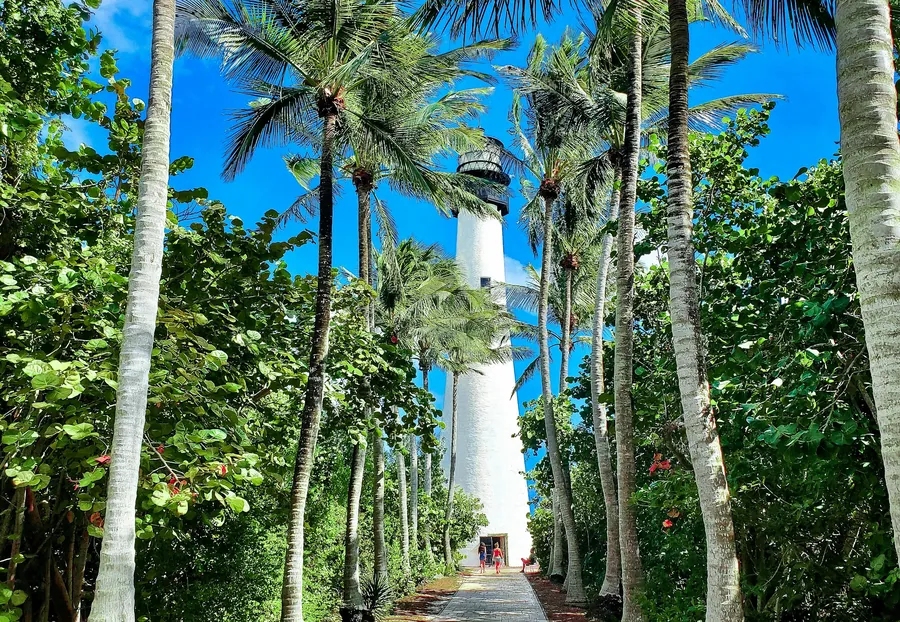
Crandon Park brings a two-mile Atlantic beach, a marina at 4000 Crandon Boulevard with slips up to 80 feet, an 18-hole par-72 golf course, the Marjory Stoneman Douglas Biscayne Nature Center and the Crandon Tennis Center, 27 courts and a 13,800-seat stadium that hosted the Miami Open from 1987 to 2018. Bill Baggs holds the Cape Florida Lighthouse, first built in 1825 and rebuilt in 1847, and a beach that has ranked among the best in the country.
Between the parks, the Village Green, the Community Center and the Key Biscayne Branch Library form the civic core, with shops and restaurants along Crandon Boulevard and at Harbor Plaza and the Galleria. There is no hospital on the island; the nearest emergency rooms are in Brickell and Coral Gables.
Schools and services
Key Biscayne K-8 Center is the Miami-Dade County Public Schools home school for the island, kindergarten through eighth grade. The zoned high school is Coral Gables High School, about 11 miles away on the mainland. MAST Academy, the district's maritime and science magnet on Virginia Key, serves grades 6 through 12 by lottery, and the Village holds a priority-admission agreement for its Cambridge programs.
Private options on the island include St. Agnes Key Biscayne, Key Biscayne Community Day School and St. Christopher's By the Sea, plus several preschools. The Village runs its own police, fire rescue, public works and building department, and the county library branch sits beside the Village Green.
- Key Biscayne K-8 CenterK-8
- MAST AcademyMagnet
- Coral Gables High SchoolHigh school
- St. Agnes Key BiscaynePrivate
- Key Biscayne Community Day SchoolPrivate
- St. Christopher's By the SeaPrivate
Buying here: what to check before you write an offer
Start with the FEMA panel for the exact address. A barrier island carries high-risk AE and VE designations on many parcels, which means mandatory flood insurance with a federally backed mortgage and premiums that depend on elevation. Ask for the elevation certificate and get flood and windstorm quotes during the inspection period.
For condos, read the milestone inspection report, the structural integrity reserve study and the last two years of board minutes. Key Colony and other 1970s and 1980s towers have been through concrete restoration cycles; find out where the building is in its cycle and whether a special assessment is pending.
For houses, pull permits on every addition, since many Mackle homes were expanded in stages. Confirm seawall condition on bay and canal lots, and read the Village's stormwater assessment schedule.
Selling here: what island buyers respond to
Buyers on Key Biscayne compare a short list of streets and buildings they already know. A house listing sells on the lot, the flood elevation, the year of the roof and impact windows, and whether the permits are closed. A condo listing sells on the building's reserve position and the view line. Have the elevation certificate, wind mitigation report and permit history ready before photos.
Inventory here moves slower than mainland Miami and prices are negotiated in larger steps, so the first two weeks matter. Price against closed sales in the same building or street from the last six months, not against active listings.
Before you offer in Key Biscayne: the checklist
- Pull the FEMA panel and elevation certificate first; premiums vary house by house.
- Condos: milestone inspection, structural reserve study and pending assessments before the offer.
- Houses: permit history on every addition, seawall condition on bay and canal lots.
- Budget the Village stormwater assessment, billed per parcel by impervious area.
- One causeway in and out; test the commute at the hour you will actually drive it.
Before you list in Key Biscayne: what works
- Have the elevation certificate, wind mitigation report and closed permits ready before listing.
- Price against closed sales in the same building or street, not active listings.
- Condo sellers: disclose the building's reserve position and inspection status up front.
- Bay and canal lots: document seawall and dock condition with recent photos and permits.
Is Key Biscayne a good place to live? Questions people ask
Is Key Biscayne in a flood zone?
Much of it. As a barrier island most parcels fall in FEMA's AE or VE zones, so a federally backed mortgage will require flood insurance and the premium depends on the home's elevation. Check the exact address with the flood tool and ask the seller for an elevation certificate.
How far is Key Biscayne from downtown Miami?
About 7 driving miles by the Rickenbacker Causeway, which lands at Brickell and I-95. Miami International Airport is 19 miles and Miami Beach 15 miles. The causeway is the only road on and off the island, so plan around its traffic and event closures at Virginia Key.
What kind of homes are in Key Biscayne?
Single-family houses on the original 1950s Mackle lots, many rebuilt as two-story homes, larger bayfront houses on Harbor Drive and Mashta Island, and beachfront condo towers from Key Colony (1979–1981) through Ocean Club, Grand Bay and Oceana. There are no townhouse tracts.
Which public schools serve Key Biscayne?
Key Biscayne K-8 Center is the zoned school through eighth grade, and Coral Gables High School is the zoned high school on the mainland. MAST Academy on Virginia Key is a Miami-Dade magnet for grades 6–12 with a Village priority agreement. Private schools include St. Agnes and Key Biscayne Community Day School.
Is Key Biscayne a good place to invest?
It is a small, supply-constrained market at the top of Miami-Dade prices, so returns come from long holds rather than quick flips. Carrying costs are real: flood and wind insurance, condo assessments and the Village stormwater fee. Seasonal rentals are regulated; confirm the rules before underwriting rental income.
What is the Village doing about sea-level rise?
Its resilience program is a 30-year set of projects: rebuilding the stormwater system with pump stations and backup generators, raising roads, beach renourishment shared with the Army Corps and Miami-Dade County, and undergrounding utilities. A 2021 zoning code lets new homes include understories to sit above future raised streets.
Talk to a Key Biscayne realtor
Budget, bedrooms, timeline. We send the current list and a straight read on the area within the day.
Or book a call